Pages

Wednesday, September 18, 2013

PRODUCT REVIEW: Leapfrog Tag

For Christmas my husband & I purchased the Tag for our son Bryce (13 months at time of Christmas).  After watching Bryce figure it out (he's still putting two and two together that to hear the words/sounds from the book you have to tap it with the pen), I must say - I am thoroughly impressed by this product.

It's easy to use.  You load it kind of like you would an iPod or Kindle, you go to Leapfrog's website and download Tag software onto your PC, then "load" books onto the Tag.  There is a space limit, but we have yet to reach it and you can swap the books on & off should that ever occur.  Honestly, I have no idea how the "pen" differentiates between books, but it is very cool - you tap the words on a page and the Tag reads it to you.  You can also tap all the characters or objects and they will make some sort of sound or talk - it's very interactive.  Another nice thing is that - if you wanted - you can just read the books like normal books.  So it's nice to know that if you ever forget your Tag, yet have the books handy, you can still use them as a form of entertainment.

The various Tag books feature a variety of characters from Disney, Nickelodeon, etc.  We are currently using the Tag Junior books as that is the level my son is at.  The books all have different learning elements, which are clearly stated on the cover, such as letter recognition, counting, etc.  The Tag Junior books are board books and cost about the same as a traditional board book - approx. $8 a book.  In my personal opinion, they don't skimp on the content either, which is nice when compared to other board books like The Very Hungry Caterpillar (a classic to be sure, but other parents know, light on content).  The Tag books will run you a little more, but are also longer - more like a traditional children's book (approx. $11-$12 each).


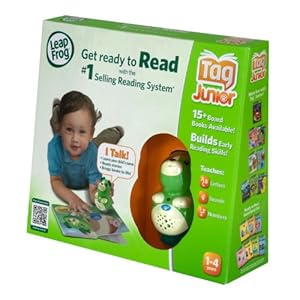
My biggest peeve about this product isn't actually about the product itself.  As I stated above, my son was only 13 months old at Christmas and as you can see from the picture the Tag is designed for children ages 4-8.  Initially, I purchased the Tag Junior (picture below).  As you can see, the Tag Junior is designed for children ages 1-4 (the category my son falls in).  The Tag Junior works the same way as the Tag, however has an easier device for small hands to hold - it's shaped like Scout (the Leapfrog puppy).  I mentioned in passing to a co-worker that I had picked one up for my son for Christmas and she told me to return it and buy the Tag.  The Tag Junior retails for $30 and the Tag retails for $32.50; however the Tag will "read" both Tag Junior and regular Tag books (Leapfrog has a progressive reading system); whereas the Tag Junior will ONLY work with Tag Junior books.  Ergo if you started with the Tag Junior, you would eventually have to purchase the Tag to progress to a higher level of books (assuming your child loved the Tag system and you wanted to continue using it).  You will also be able to verify this on the box (and the books) that the Tag works with both kinds of books, whereas the Tag Junior only works with Tag Junior books.

That being said, all in all I LOVE this product.  While I know he's young now, I already see that my son likes the "interaction" with the book that the Tag creates.  It's the same as me reading to him, but he gets to control everything - it's also helpful that he can play with it on his own, when I'm busy cooking dinner for example.  We own several Leapfrog learning products and I think they make learning fun & easy - it also helps that they're not incredibly annoying given the fact they produce sounds.  I would highly recommend this product, but I would recommend you skip the Tag Junior and just go with the Tag - the pen is wide enough that my son does not have issues holding onto it and he already has figured out which end goes on the book.

You can purchase the Tag reading system at any large retailer.  We bought ours from Wal Mart.
Here is a link to Amazon's site:
Amazon: Leapfrog Tag

Does anyone else have the Tag or another type of "reading" toy?  I'd love to hear your comments!

Disclaimer: I was not requested to review, nor was I compensated in any way.  The thoughts expressed above are mine and were observed firsthand.

Tuesday, September 17, 2013

Did you know smoke detectors expire?

My co-worker recently bought a new home and when I asked him what he was up to this weekend, he said he was heading over to Home Depot to buy new smoke detectors.  When I asked him why, he informed me that smoke detectors "expire".  I had NO IDEA!  My home will be 10 years old in 2014 so I'm now planning to replace mine as well.

For an easy to read (and follow) guide on smoke detector maintenance check out this site.

Another thing I learned, once a year you should take a vacuum to your smoke detector to clear particles out of it so sensors function effectively.

This right here is proof that you learn something new every day - hope it helps you!


Friday, September 13, 2013

Help! How can I get my new baby to sleep through the night?!

Yay – your baby is here!!  You’re breastfeeding (or formula feeding) and life is awesome.  Then a few months go by … you love your squidgy bundle of joy, but you’re starting to feel it and you’re getting tired.  Then maternity leave ends … now these middle of the night feedings are taking their toll.  What’s a mother to do?

How to get your baby to sleep through the night


This is the story of how I eliminated nighttime feedings with my son.  While I could’ve done this sooner, I got him sleeping through the night at 5 months old (I went back to work when he was 3 months old).  I consulted my pediatrician and did a bunch of research (via books & internet) and this is what worked for us.  Recognize that every baby is different, but in general – they are physically capable of sleeping through the night at anywhere from 3-5 months (it will come down to your emotional strength as a mother – you’ll see what I mean below). 

General information, tips & advice (from articles I read and my personal experience):
  •           Per my pediatrician, when babies are 11-12 lbs their tummies are physically large enough to hold enough food for them to be content through the night. (It is important to note that “through the night” generally means your baby will sleep a solid 6-8+ hours).  That is why you will often hear people say “mine started sleeping through the night at 2-3 months” (depending on the size of their baby).  Your baby should be getting approximately 2 oz per every pound they weigh of milk (whether BM or formula) per day – so if you have a 20 lb baby, they should be getting roughly 40 oz of milk per day.  This will decrease slightly as you introduce solid foods as nutrients will be consumed through the food; however your baby should consistently be getting approx. 24-32 oz per day even with food to maintain good bone/brain development.  Lastly, babies of this age should be getting approx. 14 hours total sleep throughout the day/night.
  •           Babies often follow routines – either set by parents/daycare or they set them themselves.  When trying to alter baby’s routine, you should make gradual changes and not try to change multiple things at once.  A good example is – you may notice results following the recommended steps below; however perhaps on the weekend your baby’s schedule is different from the schedule he/she follows at daycare – during the weekend you may notice relapses in your progress.  This is because you’ve tried to change too much all at once.  While trying to get your baby to sleep through the night, try to keep the rest of his/her daily routine as on point as possible (i.e. if you’re planning a trip or an outing sometime soon, maybe wait until that has passed to try changing this aspect of his/her daily routine).  Personally, we try to keep Bryce’s schedule at home on the weekend (in terms of feedings/naps) within a one hour window of when they do it at daycare – it keeps him happier and come Monday he doesn’t fuss at school when things are changed.
  •           If you’re breastfeeding, I found the following to be helpful as you try these steps: (1) baby needs to sleep in his/her own bed, in his/her own room – this is for multiple reasons, but the primary ones being (a) when you lactate in the middle of the night (i.e. leak) – baby can smell the milk and automatically assumes it’s time to wake up & eat and (b) most babies (of course every baby is different) are somewhat fitful sleepers – a baby’s REM cycle can be drastically different from an adults and they tend to sleep more towards semi-wakefulness than adults do; by limiting the amount of distractions by putting baby in his/her room (i.e. you won’t hear him/her roll over – he/she won’t hear you roll over) you increase the likelihood of baby enjoying uninterrupted, deeper sleep (and you too!) – not to mention, you’re able to increase intimate time with daddy (which is a pleasant perk) ;).   (2) when trying the steps below (as much as it sucks) – get out of bed to feed baby, go into baby’s room and sit in the rocking chair or glider to feed the baby.  Make sure baby stays awake for a complete feeding (15-30 minutes) and then put baby back to bed immediately and go back to your own bed.  Personal experience: we would start Bryce out in his bed and when he woke up (2-3x a night depending) I would go get him, pop him on the boob and come back to bed; what I came to find as I followed the steps below was that he was just “topping of his tank” (i.e. taking a few large mouthfuls and going back to sleep) – he was nursing more for comfort than nutritional value (and because it had become part of his “routine” to wake up & eat at that time).
  •           If your baby is 6 months old and you haven’t established a baby food routine (i.e. your just experimenting here or there) – establish that first.  Get baby consistently eating baby food for 3 meals a day, plus milk and then attempt to make the change.  At 6 months – each meal should consist of roughly ¼ cup cereal/oatmeal (we did oatmeal), ½ tub of baby food and 4 oz bottle of milk (including whatever milk you stir into the food) (morning & afternoon snacks should be able half that amount of food, same amount of milk).
  •           Never wake baby up to eat, only respond to baby.  Maintaining the cycle of nighttime feeding is counterproductive to getting baby to sleep through the night.  Also, if you haven’t already – don’t change baby at night unless baby has gone poop or is excessively damp.  An obvious tip – keep lighting very dim or none at all.  The less you disturb baby, the better. 

Ok – so now to the process, lol – if you follow the steps below you should be able to wean your baby of nighttime feedings within 1-2 weeks (depending on how you proceed):

Step 1: Observe routine: unless your baby already has a set routine of times they wake up, for the first day or two observe your baby: what times do they wake up, how many ounces do they eat at each nightly feeding (for breastfeeding: how long is baby “actively” nursing – not just suckling a mouthful here or there – yes, you’ll need to stay awake for this process).  If baby is being sporadic (i.e. sleeping through the night and then randomly not) – it’s probably one of two things: (1) baby is going through a growth spurt (should last anywhere from 2-5 days) or (2) something else in baby’s routine has recently been changed and baby is still adjusting.  If the wakefulness is sporadic (especially if it’s a growth spurt): respond to baby’s needs, but after a few nights make an effort to return to the routine of sleeping through the night so baby doesn’t get “used” to waking up to eat in the middle of the night again.

Step 2: Decrease ounces per feeding: Now that you know when you’re baby wakes up and how much he eats – it’s time to “wean” him off the nighttime feedings.  IMPORTANT NOTE: per my tip above, baby should be getting anywhere from 24-40 oz of milk per day – if he’s already getting that much during the day, then you don’t need to be as observant about eliminating nighttime feedings; however if baby is a finicky eater during the day and tends to chow down at night, you will need to be hyper observant during the day (ask for reports from daycare if necessary) – baby’s ounce intake per feeding should increase during the day as you eliminate nighttime feedings (you’re “shifting” baby’s eating schedule).  If your baby generally eats 4 oz per nighttime feeding, reduce the amount to 3 oz on the first night, then 2 oz on the second & third nights and then 1 oz on the fourth & fifth night (if you’re breastfeeding, reduce the number of minutes you feed – go from 20 min to 15 min to 10 min).  As you decrease the number of ounces, the number of nighttime feedings should naturally decrease (i.e. if he’s waking up 2-3x a night, hopefully one nighttime feeding will automatically take care of itself).

Step 3: Eliminate feedings (this is the most difficult step): After you’ve gotten your baby down to approx. an ounce of milk for his/her nighttime feeding (or approx. 5-10 min on the breast), it’s time to eliminate the nighttime feedings altogether.  If baby is still waking up 2-3x per night, eliminate one nighttime feeding at a time (usually eliminate this feeding for approx. 2 days then begin trying to eliminate another).  If baby wakes up 3x per night, eliminate the first and last feedings first – then the feeding in the middle of the night.  Here comes the hard part: baby will continue to wake up (remember, it’s still part of his/her routine) – you’ve already established he/she doesn’t really “need” anything (because you’ve gotten him/her down to hardly any milk); ignore baby for 5-10 minutes (if crying persists past 10 min, get up – feed baby the ounce you’ve gotten down to and try again the next night).  This may last for 2-5 nights, but eventually baby will realize (a) he/she doesn’t need to wake up and (b) he/she doesn’t want to.

I won’t lie to you – this was, to date, the hardest thing I’ve had to do as a mother – ignore my crying child; however it is important for baby to get a good quality of sleep (and for mommy, lol) – so by getting through this, we’ve both been better for it.  I haven’t researched if there’s any evidence of it, but I would tend the think the older baby gets, the more difficult it is to “shake up” their routine (like when moms try to wean babies from pacifiers or bottles).  Also, when baby transitions to the 1 year old room at daycare, they only take one two hour nap a day, so it’s important to get baby sleeping through the night so he/she gets enough “overall” sleep throughout the day (they continue to need 10-12 hours a day at 1).  Other moms have recommended a bedtime routine to help – I’m sure that works for some moms, honestly we have no routine (though we do try to eat dinner around the same time every night) and Bryce naturally puts himself to bed between 8-9 pm.  We do actively play with him from the time we get home (6:30pm) until dinner (7:30-7:45pm) and then we calm down.

I wish you all the best of luck with this – know it won’t be easy, but you’ll both be better for it on the other side.  Also, I hope what I wrote didn’t offend anybody – this is just the route our family went and it worked for us.  Every baby (and every family) is different and has to find what works for them.  If you have suggestions on how to get baby to sleep through the night - let me know below!  Also, if you try this method, let me know how it works for you!

Main reason I had issues initially getting my son to sleep through the night (I went back to sleep too!)





Car seat safety: how long should my child be rear facing?

This is a question that comes with a lot of parental opinions.  I know moms whose 1 year olds are forward facing and I know moms whose 5 year olds are rear facing.  I was fortunate enough to have a friend who linked me up with some great resources regarding car seat safety and the safety of my son.

My story: When my son was born we had the Graco Snugride car seat (great seat!) - however, we bought this seat used off Craigslist which I later learned was a big no no.  His convertible seat was bought new online - a Britax Marathon (great seat, I love it) - however, I later learned that Britax seats are best for children under the 30% for height for rear facing.  The reason being that in rear facing mode the straps need to come from below the child's shoulders and you should have an inch of shell remaining above the top of the head - never going to happen for my kid.  When my son was about 14 months old, I went ahead and flipped him front facing - he seemed to enjoy being able to see & interact with me more.  At 21 months (after all I have learned), I returned him to rear facing and plan to keep him that way as long as possible (preferably to age 4).  I just ordered him a Diono Radian RXT car seat to accomplish this.

Instead of trying to explain the many reasons why rear facing is preferable to front facing, I will show you this simple YouTube video by way of explanation:

Now, you may be asking yourself: ok - yes, rear facing is safer, but how long do I need to do it?  Well, if I'm honest - the US is a bit behind a lot of other countries in this regard.  The AAP just recently revised their opinion that you should rear face a child until a minimum of age 2; however the consensus among car seat technicians (and our friends across the pond) seems to be age 4 as this is when spinal ossification occurs.  The older your child is when you decide to forward face, the better - your child's body is more proportional the older they get (whereas with babies through age 2/3 most people notice that their children appear to have "large" heads - i.e. their head is not proportional to the rest of their body).

Now - here is the real reason I wrote this post.  A lot of parents tend to complain, "oh I can't see my child", or "oh, my child is uncomfortable with their legs all squished up".  This is simply not true - small children are super bendy and are perfectly comfortable riding rear facing.  Car Seats for the Littles recently put out this great article: Rear Facing Car Seat Myths Busted.  I highly recommend you give it a read.

What are your opinions are rear facing vs forward facing in a car seat?

Other informative links:

See our other posts on car seat safety:
My son is his Britax Marathon - rear facing.  Approx. 33 in & 26 lbs


Thursday, September 12, 2013

The Cash Challenge

In this modern world of debit and credit cards (not to mention online shopping!) - paying with cash has kind of become taboo.  I've even noticed in line at the grocery store people huffing because the person in front of them is paying with cash and it takes longer, cashier has to verify and give change, etc.  BUT - can you SAVE money if you just use cash?

Honestly, you could probably stop reading right here and have your answer.  YES, I could save money if I only used cash.  Why?  Well (a) I can't buy anything on the internet using cash and (b) when I'm forced to actually hand over my hard earned money, I think about the transaction a bit more than when I swipe my debit card.  And all of us know swiping our credit card equates to spending money that was never really ours in the first place.  Turns out there have been studies that show we're willing to spend a lot more when we use our cards versus cash - up to 100% more!

So what is the cash challenge?  Roughly analyze your spending habits (or what you "think" they are) and at the beginning of the month take out that amount of money from an ATM in cash.  For example, if you spend $500 a month (not including things like mortgage, utilities or other bills you pay online) then take our $500 in cash.  Now here comes the trick - you have to make this amount last for the month.  At the gas station, out to dinner, at the grocery store, for daily lunch or coffee ... all of that extra discretionary spending.  Do you think you'd make it to the end of the month?

Personally, I know I would not.  I have a love for Amazon.com and all other sorts of online shopping.  However, it is a goal of mine to save to contribute towards household projects so I am going to propose the cash challenge to my husband for October.  As a side note, I actually do track all of our spending in Quickbooks software and break it down by category (hey, I'm a type A accountant - don't judge) so I will be super anal about collecting receipts during this process.

How the challenge actually works:

  • Take out your monthly discretionary spending amount at the beginning of the month and put it in an envelope in your desk drawer or some other safe space.  Also place a pen & notebook nearby.
  • Everyday (or however often you need to), take out an amount of cash.  Use the notebook as a type of check register - write down the beginning balance (ex: $500) and how much you took out.  For extra information (to see how bad your spending habits really are) write down what you intend to use the money for - then at the end of the day, revisit the notebook and write down what you REALLY spent the money on.
  • See if you make it until the end of the month.
Not only will this help have more respect for your money - if you're really hoping to save, this is a great first step because it will show you your money may not go as far as you think it does (especially if you've been supplementing your spending with credit).

Give it a try - then come back here and let me know how it went for you.  Or if you've already tried the cash challenge, how did it work for you and what did you learn?


Ladies: how many bras do you really need?

Ok I realize I'm the exception and not the norm, but I kind of only own one bra at a time and then replace.  My bra gets washed once a week and I work a normal desk job (so not a lot of sweating going on).  Basically the minute I get home, the darn thing is off and I'm in a comfy tee and some shorts.  Now I may be kind of a hippie, but I don't like bras.  I mean - we all have breasts, what's the big deal?  After the birth of my son, I got even more blase about it because (let's face it) those girls are never going back to their prim & proper state after breastfeeding.

After reading some recent articles it seems the norm is five bras:

  • One "fun" bra
  • Two everyday bras - most common colors nude & black
  • One convertible/strapless bra
  • One sports bra
However, it would appear that on average at any give time women can own up to 16 bras at a time and buy about 4 new bras a year.  Apparently we'll spend roughly $4,000 in our lifetime on (you guessed it) bras!

Back to the above list - to be fair, I do own a sports bra and a nursing bra, but I don't own a single strapless bra.  Underwires are so uncomfortable to me.  Can you tell I'm a tshirt and flip flops kind of girl?  I don't much care for high heels either (especially chasing my  2 year old around ...).

How many bras do you own?  Any advice for me to expand my collection?


Wednesday, September 11, 2013

Remembering the tragedy of 9/11

Throughout history there have been several horrific events, we learn about them in history class all the time.  However, up until I hit 11th grade - I'd only lived through one or two - and had no memory of either.  As I sat in my mid-morning calculus class, it was just any other day in the life of a typical high school student, I was struggling to understand what the heck my teacher was talking about when another teacher came in and very quietly spoke to our teacher (Ms. Jones - yes, I still remember her name as well).  Ms. Jones went over to the class TV and turned on CNN and said we were done with class for the day as there was an emergency situation.

Now you have to understand - I was born in the '80's ... the Cold War was over, I had never lived through a real "war" - yes, there was Desert Storm in the early '90's, but that was a foreign conflict fought overseas.  I had never been directly impacted by a violent situation within our borders.  I had never even had the bomb training at school my parents had (where you hide under your desk).

When the news came up and showed a combination of live footage and flashback footage of the planes hitting the towers all I could think was - "this has got to be a trailer for an upcoming movie or something".  I had never (and have never since then) seen anything like it.  It has totally put other things in perspective for me in relation to my family members - my dad was in the Navy during Vietnam, my grandmother was alive during the Great Depression and WWII ... when they tell me about those times, all they ever were to me was stories.  Sad stories to be sure that we should learn life lessons from, but stories all the same.

But this - I lived through this.  I lived through something that will show up in every history book written from 2002 forward.  It's crazy.  Someday my son will go to school and he will learn about that tragic day and I'll tell him where I was and how I felt - scared.  I was scared - scared for myself, for my family - for all the people in New York who I didn't even know.  But I was also proud - proud of the way we as a people came together and helped one another.  First responders rushed in (and many died) trying to help their fellow man - going above and beyond the call of duty.

No matter how you feel about the political actions that followed the tragic events of 9/11 - this will always be a day of remembrance for every American who was alive and watching the news that day.  Whether you were directly impacted or not, that day solicited strong emotions in us all and I believe it's important to reflect back and remember where you were and how you felt.

Where were you on 9/11 and what emotions were you going through?