Pages

Showing posts with label parenting. Show all posts

Tuesday, March 18, 2014

Fun craft time with your toddler

The longer I'm a mom, the more I realize it's up to me to enrich my child's life.  Yes, his daycare is wonderful - they sing, dance, play games, do arts & crafts and have a jolly good time, but I also feel like part of that is my responsibility as his mother (plus I want to do all that fun stuff with him too).

Initially I was very daunted by the idea of trying to organize activities for my son (he'll be 2.5 next month), that's when I had an "ah ha" moment.  Toddlers have super short attention spans.  I didn't need to plan activities that would last for hours - just a short 10-30 minutes.  Once I had this realization, I started Googling and doing different crafting activities with my son - sometimes it's just coloring in a coloring book (but hey, we're doing it together) - other times I put a bit more effort into it and we "make" something.

To date we've made a telescope from a papertowel roll (which we covered in construction paper bits and painted) and this past weekend we made a paper bag puppet (who got his hair removed the moment we were done, lol).

Point is, don't be intimidated mommies!  There are lots of great resources out there and these crafts don't take a lot of time (or money ... or if you're like me, creativity).  The main things I learned are that (1) it doesn't have to be something super well thought out; (2) it doesn't have to be priceless work of art you'll want to frame and keep forever; (3) have fun with it - get involved with your toddler and (4) encourage their inner artist simply by presenting them with these opportunities to be creative.

Here are some great links of sites with craft ideas and a few inspirational pictures of my son's own handy work :)


Sunday, March 16, 2014

To vaccinate or not to vaccinate?

The mainstream media has blown this issue way out of proportion lately - I'm sure you've seen all the articles about how anti-vaxxers are causing massive "outbreaks".  OK, first off - take a breath, there is no need for mass hysteria unless you consider less than 200 cases across the entire US in 2013 to be an "outbreak".

Some back story - here is a link to one of the articles I'm referencing: Thanks, Anti-Vaxxers. You Just Brought Back Measles in NYC.

Here is a very well written rebuttal by another blog writer, Jessica Gianelloni: Thanks, Pharma. You created the “anti-vaccine movement”.

The purpose of my article today is not to take a stance on either side - you, as a parent, have to ultimately make the decisions that you believe are right for your children & family.  If you vaccinate, great - if you don't, that's OK too.  As a parent, I would never blame an unvaccinated child for an "outbreak" because statstically speaking, odds are low the "outbreak" came from an unvaccinated child - odds are higher that it came from (1) someone who traveled outside the country and did not obtain the proper boosters before travel; (2) someone who had the vaccine as a child, but did not maintain their boosters as an adults or (3) someone who recently obtained the vaccine and had a negative response (you've heard of people contracting the flu from the flu shot yes?).

The purpose of my article is simply to say: as parents we have choices.  We can't let fearmongering articles like The Daily Beast article above influence our decisions as parents.  We know the research is there, both pro-vaccine and anti-vaccine.  It's up to us as parents to read the research, process what it says and make decisions regarding how we want to move forward.

See: How Facebook Can Sway Parents' Decision to Vaccinate Their Kids

Personally, we decided to follow the CDC guidelines for my son (some of his shots are delayed).  I did a lot of research (especially around the possibility of vaccines causing autism) and came to the conclusion for myself that the recommended route was OK and safe for my son and would protect him should he be potentially exposed to one of the diseases he's vaccinated against (yes, I did the chicken pox one too - I could write an entire new article about that decision).  That does not mean that I believe every other parent should do what I chose to do - they have to make that decision independently for themselves.

There have also been interesting articles from personal, individual experiences (like this one from Slate).  The thing I find interesting in this article that I'd like to research more is this: does being vaccinated naturally strengthen our immune systems in other ways?  My son is 2.5 - he's had a handful of sick visits to the doctor in that time (mostly due to my paranoia as a first time mother, more so than any sickness), he's missed 1-2 days of daycare max for sickness (teething related fever) and has received mild antibiotics 2-4 times (mostly just amoxicillin).  I can't help but wonder if there is a correlation between my son being vaccinated and his almost complete lack of illness since birth (granted there are other factors to consider, his diet, our overall household health [I've been sick quite a bit since he was born], his exposure to environmental elements, etc).  It's something I plan to do more research on as my husband & I talk about expanding our family.

Since I've now rambled on, let me just leave you with this: at the end of the day, as a parent - you make the choices regarding how you raise your children.  That's always how it goes: parents make the choices, but we also suffer from any unintended consequences.  Lord knows as a mom, I've made a decision one way I've later regretted.  All we can do as parents is learn, grow and change along the way.


Wednesday, September 18, 2013

Winter Car Seat Coat Rules

Since it has started cooling down for fall and approaching winter, I figured I would go ahead and share the following: wearing winter coats in a car seat is a huge no no.  The thickest item a child should ever have on is the equivalent of a thin fleece jacket.  When in doubt on whether an item is ok for a child to wear in a car seat, put the jacket (or whatever it is) on the child and put them in the car seat - adjust straps accordingly.  Then remove the child, take the jacket off and put the child back in the car seat.  If the straps fail the pinch test, that clothing item is too bulky and should not be worn by the child in the car seat.

Some tips to keep kids warm:

  • Put jackets on backwards after child is strapped in car seat.
  • Cover car seat with blanket.
  • Turn car on and get it warmed up prior to putting child in car seat.
If you're still thinking, it's ok - see these pictures and YouTube video below:


PRODUCT REVIEW: Leapfrog Tag

For Christmas my husband & I purchased the Tag for our son Bryce (13 months at time of Christmas).  After watching Bryce figure it out (he's still putting two and two together that to hear the words/sounds from the book you have to tap it with the pen), I must say - I am thoroughly impressed by this product.

It's easy to use.  You load it kind of like you would an iPod or Kindle, you go to Leapfrog's website and download Tag software onto your PC, then "load" books onto the Tag.  There is a space limit, but we have yet to reach it and you can swap the books on & off should that ever occur.  Honestly, I have no idea how the "pen" differentiates between books, but it is very cool - you tap the words on a page and the Tag reads it to you.  You can also tap all the characters or objects and they will make some sort of sound or talk - it's very interactive.  Another nice thing is that - if you wanted - you can just read the books like normal books.  So it's nice to know that if you ever forget your Tag, yet have the books handy, you can still use them as a form of entertainment.

The various Tag books feature a variety of characters from Disney, Nickelodeon, etc.  We are currently using the Tag Junior books as that is the level my son is at.  The books all have different learning elements, which are clearly stated on the cover, such as letter recognition, counting, etc.  The Tag Junior books are board books and cost about the same as a traditional board book - approx. $8 a book.  In my personal opinion, they don't skimp on the content either, which is nice when compared to other board books like The Very Hungry Caterpillar (a classic to be sure, but other parents know, light on content).  The Tag books will run you a little more, but are also longer - more like a traditional children's book (approx. $11-$12 each).


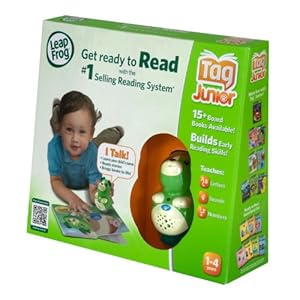
My biggest peeve about this product isn't actually about the product itself.  As I stated above, my son was only 13 months old at Christmas and as you can see from the picture the Tag is designed for children ages 4-8.  Initially, I purchased the Tag Junior (picture below).  As you can see, the Tag Junior is designed for children ages 1-4 (the category my son falls in).  The Tag Junior works the same way as the Tag, however has an easier device for small hands to hold - it's shaped like Scout (the Leapfrog puppy).  I mentioned in passing to a co-worker that I had picked one up for my son for Christmas and she told me to return it and buy the Tag.  The Tag Junior retails for $30 and the Tag retails for $32.50; however the Tag will "read" both Tag Junior and regular Tag books (Leapfrog has a progressive reading system); whereas the Tag Junior will ONLY work with Tag Junior books.  Ergo if you started with the Tag Junior, you would eventually have to purchase the Tag to progress to a higher level of books (assuming your child loved the Tag system and you wanted to continue using it).  You will also be able to verify this on the box (and the books) that the Tag works with both kinds of books, whereas the Tag Junior only works with Tag Junior books.

That being said, all in all I LOVE this product.  While I know he's young now, I already see that my son likes the "interaction" with the book that the Tag creates.  It's the same as me reading to him, but he gets to control everything - it's also helpful that he can play with it on his own, when I'm busy cooking dinner for example.  We own several Leapfrog learning products and I think they make learning fun & easy - it also helps that they're not incredibly annoying given the fact they produce sounds.  I would highly recommend this product, but I would recommend you skip the Tag Junior and just go with the Tag - the pen is wide enough that my son does not have issues holding onto it and he already has figured out which end goes on the book.

You can purchase the Tag reading system at any large retailer.  We bought ours from Wal Mart.
Here is a link to Amazon's site:
Amazon: Leapfrog Tag

Does anyone else have the Tag or another type of "reading" toy?  I'd love to hear your comments!

Disclaimer: I was not requested to review, nor was I compensated in any way.  The thoughts expressed above are mine and were observed firsthand.

Tuesday, September 17, 2013

Did you know smoke detectors expire?

My co-worker recently bought a new home and when I asked him what he was up to this weekend, he said he was heading over to Home Depot to buy new smoke detectors.  When I asked him why, he informed me that smoke detectors "expire".  I had NO IDEA!  My home will be 10 years old in 2014 so I'm now planning to replace mine as well.

For an easy to read (and follow) guide on smoke detector maintenance check out this site.

Another thing I learned, once a year you should take a vacuum to your smoke detector to clear particles out of it so sensors function effectively.

This right here is proof that you learn something new every day - hope it helps you!


Friday, September 13, 2013

Help! How can I get my new baby to sleep through the night?!

Yay – your baby is here!!  You’re breastfeeding (or formula feeding) and life is awesome.  Then a few months go by … you love your squidgy bundle of joy, but you’re starting to feel it and you’re getting tired.  Then maternity leave ends … now these middle of the night feedings are taking their toll.  What’s a mother to do?

How to get your baby to sleep through the night


This is the story of how I eliminated nighttime feedings with my son.  While I could’ve done this sooner, I got him sleeping through the night at 5 months old (I went back to work when he was 3 months old).  I consulted my pediatrician and did a bunch of research (via books & internet) and this is what worked for us.  Recognize that every baby is different, but in general – they are physically capable of sleeping through the night at anywhere from 3-5 months (it will come down to your emotional strength as a mother – you’ll see what I mean below). 

General information, tips & advice (from articles I read and my personal experience):
  •           Per my pediatrician, when babies are 11-12 lbs their tummies are physically large enough to hold enough food for them to be content through the night. (It is important to note that “through the night” generally means your baby will sleep a solid 6-8+ hours).  That is why you will often hear people say “mine started sleeping through the night at 2-3 months” (depending on the size of their baby).  Your baby should be getting approximately 2 oz per every pound they weigh of milk (whether BM or formula) per day – so if you have a 20 lb baby, they should be getting roughly 40 oz of milk per day.  This will decrease slightly as you introduce solid foods as nutrients will be consumed through the food; however your baby should consistently be getting approx. 24-32 oz per day even with food to maintain good bone/brain development.  Lastly, babies of this age should be getting approx. 14 hours total sleep throughout the day/night.
  •           Babies often follow routines – either set by parents/daycare or they set them themselves.  When trying to alter baby’s routine, you should make gradual changes and not try to change multiple things at once.  A good example is – you may notice results following the recommended steps below; however perhaps on the weekend your baby’s schedule is different from the schedule he/she follows at daycare – during the weekend you may notice relapses in your progress.  This is because you’ve tried to change too much all at once.  While trying to get your baby to sleep through the night, try to keep the rest of his/her daily routine as on point as possible (i.e. if you’re planning a trip or an outing sometime soon, maybe wait until that has passed to try changing this aspect of his/her daily routine).  Personally, we try to keep Bryce’s schedule at home on the weekend (in terms of feedings/naps) within a one hour window of when they do it at daycare – it keeps him happier and come Monday he doesn’t fuss at school when things are changed.
  •           If you’re breastfeeding, I found the following to be helpful as you try these steps: (1) baby needs to sleep in his/her own bed, in his/her own room – this is for multiple reasons, but the primary ones being (a) when you lactate in the middle of the night (i.e. leak) – baby can smell the milk and automatically assumes it’s time to wake up & eat and (b) most babies (of course every baby is different) are somewhat fitful sleepers – a baby’s REM cycle can be drastically different from an adults and they tend to sleep more towards semi-wakefulness than adults do; by limiting the amount of distractions by putting baby in his/her room (i.e. you won’t hear him/her roll over – he/she won’t hear you roll over) you increase the likelihood of baby enjoying uninterrupted, deeper sleep (and you too!) – not to mention, you’re able to increase intimate time with daddy (which is a pleasant perk) ;).   (2) when trying the steps below (as much as it sucks) – get out of bed to feed baby, go into baby’s room and sit in the rocking chair or glider to feed the baby.  Make sure baby stays awake for a complete feeding (15-30 minutes) and then put baby back to bed immediately and go back to your own bed.  Personal experience: we would start Bryce out in his bed and when he woke up (2-3x a night depending) I would go get him, pop him on the boob and come back to bed; what I came to find as I followed the steps below was that he was just “topping of his tank” (i.e. taking a few large mouthfuls and going back to sleep) – he was nursing more for comfort than nutritional value (and because it had become part of his “routine” to wake up & eat at that time).
  •           If your baby is 6 months old and you haven’t established a baby food routine (i.e. your just experimenting here or there) – establish that first.  Get baby consistently eating baby food for 3 meals a day, plus milk and then attempt to make the change.  At 6 months – each meal should consist of roughly ¼ cup cereal/oatmeal (we did oatmeal), ½ tub of baby food and 4 oz bottle of milk (including whatever milk you stir into the food) (morning & afternoon snacks should be able half that amount of food, same amount of milk).
  •           Never wake baby up to eat, only respond to baby.  Maintaining the cycle of nighttime feeding is counterproductive to getting baby to sleep through the night.  Also, if you haven’t already – don’t change baby at night unless baby has gone poop or is excessively damp.  An obvious tip – keep lighting very dim or none at all.  The less you disturb baby, the better. 

Ok – so now to the process, lol – if you follow the steps below you should be able to wean your baby of nighttime feedings within 1-2 weeks (depending on how you proceed):

Step 1: Observe routine: unless your baby already has a set routine of times they wake up, for the first day or two observe your baby: what times do they wake up, how many ounces do they eat at each nightly feeding (for breastfeeding: how long is baby “actively” nursing – not just suckling a mouthful here or there – yes, you’ll need to stay awake for this process).  If baby is being sporadic (i.e. sleeping through the night and then randomly not) – it’s probably one of two things: (1) baby is going through a growth spurt (should last anywhere from 2-5 days) or (2) something else in baby’s routine has recently been changed and baby is still adjusting.  If the wakefulness is sporadic (especially if it’s a growth spurt): respond to baby’s needs, but after a few nights make an effort to return to the routine of sleeping through the night so baby doesn’t get “used” to waking up to eat in the middle of the night again.

Step 2: Decrease ounces per feeding: Now that you know when you’re baby wakes up and how much he eats – it’s time to “wean” him off the nighttime feedings.  IMPORTANT NOTE: per my tip above, baby should be getting anywhere from 24-40 oz of milk per day – if he’s already getting that much during the day, then you don’t need to be as observant about eliminating nighttime feedings; however if baby is a finicky eater during the day and tends to chow down at night, you will need to be hyper observant during the day (ask for reports from daycare if necessary) – baby’s ounce intake per feeding should increase during the day as you eliminate nighttime feedings (you’re “shifting” baby’s eating schedule).  If your baby generally eats 4 oz per nighttime feeding, reduce the amount to 3 oz on the first night, then 2 oz on the second & third nights and then 1 oz on the fourth & fifth night (if you’re breastfeeding, reduce the number of minutes you feed – go from 20 min to 15 min to 10 min).  As you decrease the number of ounces, the number of nighttime feedings should naturally decrease (i.e. if he’s waking up 2-3x a night, hopefully one nighttime feeding will automatically take care of itself).

Step 3: Eliminate feedings (this is the most difficult step): After you’ve gotten your baby down to approx. an ounce of milk for his/her nighttime feeding (or approx. 5-10 min on the breast), it’s time to eliminate the nighttime feedings altogether.  If baby is still waking up 2-3x per night, eliminate one nighttime feeding at a time (usually eliminate this feeding for approx. 2 days then begin trying to eliminate another).  If baby wakes up 3x per night, eliminate the first and last feedings first – then the feeding in the middle of the night.  Here comes the hard part: baby will continue to wake up (remember, it’s still part of his/her routine) – you’ve already established he/she doesn’t really “need” anything (because you’ve gotten him/her down to hardly any milk); ignore baby for 5-10 minutes (if crying persists past 10 min, get up – feed baby the ounce you’ve gotten down to and try again the next night).  This may last for 2-5 nights, but eventually baby will realize (a) he/she doesn’t need to wake up and (b) he/she doesn’t want to.

I won’t lie to you – this was, to date, the hardest thing I’ve had to do as a mother – ignore my crying child; however it is important for baby to get a good quality of sleep (and for mommy, lol) – so by getting through this, we’ve both been better for it.  I haven’t researched if there’s any evidence of it, but I would tend the think the older baby gets, the more difficult it is to “shake up” their routine (like when moms try to wean babies from pacifiers or bottles).  Also, when baby transitions to the 1 year old room at daycare, they only take one two hour nap a day, so it’s important to get baby sleeping through the night so he/she gets enough “overall” sleep throughout the day (they continue to need 10-12 hours a day at 1).  Other moms have recommended a bedtime routine to help – I’m sure that works for some moms, honestly we have no routine (though we do try to eat dinner around the same time every night) and Bryce naturally puts himself to bed between 8-9 pm.  We do actively play with him from the time we get home (6:30pm) until dinner (7:30-7:45pm) and then we calm down.

I wish you all the best of luck with this – know it won’t be easy, but you’ll both be better for it on the other side.  Also, I hope what I wrote didn’t offend anybody – this is just the route our family went and it worked for us.  Every baby (and every family) is different and has to find what works for them.  If you have suggestions on how to get baby to sleep through the night - let me know below!  Also, if you try this method, let me know how it works for you!

Main reason I had issues initially getting my son to sleep through the night (I went back to sleep too!)


Car seat safety: how long should my child be rear facing?

This is a question that comes with a lot of parental opinions.  I know moms whose 1 year olds are forward facing and I know moms whose 5 year olds are rear facing.  I was fortunate enough to have a friend who linked me up with some great resources regarding car seat safety and the safety of my son.

My story: When my son was born we had the Graco Snugride car seat (great seat!) - however, we bought this seat used off Craigslist which I later learned was a big no no.  His convertible seat was bought new online - a Britax Marathon (great seat, I love it) - however, I later learned that Britax seats are best for children under the 30% for height for rear facing.  The reason being that in rear facing mode the straps need to come from below the child's shoulders and you should have an inch of shell remaining above the top of the head - never going to happen for my kid.  When my son was about 14 months old, I went ahead and flipped him front facing - he seemed to enjoy being able to see & interact with me more.  At 21 months (after all I have learned), I returned him to rear facing and plan to keep him that way as long as possible (preferably to age 4).  I just ordered him a Diono Radian RXT car seat to accomplish this.

Instead of trying to explain the many reasons why rear facing is preferable to front facing, I will show you this simple YouTube video by way of explanation:

Now, you may be asking yourself: ok - yes, rear facing is safer, but how long do I need to do it?  Well, if I'm honest - the US is a bit behind a lot of other countries in this regard.  The AAP just recently revised their opinion that you should rear face a child until a minimum of age 2; however the consensus among car seat technicians (and our friends across the pond) seems to be age 4 as this is when spinal ossification occurs.  The older your child is when you decide to forward face, the better - your child's body is more proportional the older they get (whereas with babies through age 2/3 most people notice that their children appear to have "large" heads - i.e. their head is not proportional to the rest of their body).

Now - here is the real reason I wrote this post.  A lot of parents tend to complain, "oh I can't see my child", or "oh, my child is uncomfortable with their legs all squished up".  This is simply not true - small children are super bendy and are perfectly comfortable riding rear facing.  Car Seats for the Littles recently put out this great article: Rear Facing Car Seat Myths Busted.  I highly recommend you give it a read.

What are your opinions are rear facing vs forward facing in a car seat?

Other informative links:

See our other posts on car seat safety:
My son is his Britax Marathon - rear facing.  Approx. 33 in & 26 lbs


Thursday, September 12, 2013

The Cash Challenge

In this modern world of debit and credit cards (not to mention online shopping!) - paying with cash has kind of become taboo.  I've even noticed in line at the grocery store people huffing because the person in front of them is paying with cash and it takes longer, cashier has to verify and give change, etc.  BUT - can you SAVE money if you just use cash?

Honestly, you could probably stop reading right here and have your answer.  YES, I could save money if I only used cash.  Why?  Well (a) I can't buy anything on the internet using cash and (b) when I'm forced to actually hand over my hard earned money, I think about the transaction a bit more than when I swipe my debit card.  And all of us know swiping our credit card equates to spending money that was never really ours in the first place.  Turns out there have been studies that show we're willing to spend a lot more when we use our cards versus cash - up to 100% more!

So what is the cash challenge?  Roughly analyze your spending habits (or what you "think" they are) and at the beginning of the month take out that amount of money from an ATM in cash.  For example, if you spend $500 a month (not including things like mortgage, utilities or other bills you pay online) then take our $500 in cash.  Now here comes the trick - you have to make this amount last for the month.  At the gas station, out to dinner, at the grocery store, for daily lunch or coffee ... all of that extra discretionary spending.  Do you think you'd make it to the end of the month?

Personally, I know I would not.  I have a love for Amazon.com and all other sorts of online shopping.  However, it is a goal of mine to save to contribute towards household projects so I am going to propose the cash challenge to my husband for October.  As a side note, I actually do track all of our spending in Quickbooks software and break it down by category (hey, I'm a type A accountant - don't judge) so I will be super anal about collecting receipts during this process.

How the challenge actually works:

  • Take out your monthly discretionary spending amount at the beginning of the month and put it in an envelope in your desk drawer or some other safe space.  Also place a pen & notebook nearby.
  • Everyday (or however often you need to), take out an amount of cash.  Use the notebook as a type of check register - write down the beginning balance (ex: $500) and how much you took out.  For extra information (to see how bad your spending habits really are) write down what you intend to use the money for - then at the end of the day, revisit the notebook and write down what you REALLY spent the money on.
  • See if you make it until the end of the month.
Not only will this help have more respect for your money - if you're really hoping to save, this is a great first step because it will show you your money may not go as far as you think it does (especially if you've been supplementing your spending with credit).

Give it a try - then come back here and let me know how it went for you.  Or if you've already tried the cash challenge, how did it work for you and what did you learn?


Saturday, September 7, 2013

Should you pay your child for good grades?

A few years back there was an article in USA Today about school systems providing monetary rewards for kids who do well in school (and on tests ...).

My personal experience growing up is that we were paid for good grades (like $5 for every A or something like that); however as I grew up I realized this system of reward could also be skewed (for example: I got a B in AP Bio while my sister got an A in the lowest level science class - she got $5 and I did not).

I haven't thought about this issue yet and what I'll do about it - after all, my son is only almost 2.  However, after reading a few blog posts lately on the topic I do have some thoughts and I'm curious to see what yours are as well.  At the end of the day, what I desire most is for my son to have a genuine passion for learning - I don't want to have to bribe him to get up and go to school and do well just for some monetary reward on the back end, I want him to get joy from the educational experience.

We make learning activities fun at our house - when we're practicing counting or our letters, often times snacks are involved (how many grapes do I have?).  I'm hoping to instill in my son at a young age, a joy for learning - a curiosity to be sated through books & education.  Will I reward him for a job well done in school?  More than likely.  Will I promise him on the front end of a school year that good grades will equal rewards?  Probably not.  I would prefer for him to make the association that hard work in turn equals rewards since this is how the real world works (good employees earn raises and promotions, they aren't promised them when they're hired).  I also think I will reward him in other ways aside from money - if he does really well in school perhaps we'll take a trip to some foreign country as a family where we can have fun and learn about other cultures.  If he does really well on a test, perhaps when he asks for something on one of our shopping trips out, I'll agree and say something to the effect of "you've done so well in school this week, I'm really proud of you - if you want that toy, I'll buy it for you".

I guess my conclusion on the whole matter is - I believe children should be rewarded for performance well done, I'm just not sure I agree with the whole approach of cash payments for good grades.  What are your thoughts on this matter?


Disclaimer: this post is purely my opinion and is not meant to offend any one in any way.  If you choose to comment on this post, please do so respectfully.

Tuesday, September 3, 2013

What your child can teach you about happiness

This is one of the BEST articles I've seen in a long time: 18 Things Children Can Teach Us About Happiness by Melissa Sher.

Reading this truly touched my heart because I see all these traits in my 2 year old son Bryce (except maybe the ones about sleeping - the kid almost never willingly wants to sleep).

This article brought to mind one particular event with my son, one day he was out playing in the backyard when I was indoors doing (what else) some light cleaning (read: picking up my toddlers mess ... again!).  I hadn't noticed that it hard started to rain (but we live in Florida, so that happens a lot) when suddenly I heard giggles coming from the back yard.  When I went to investigate, all I could do was smile.  I quickly ran back inside and grabbed my camera to snap a few shots - my son was outside, fully dressed - dancing and playing in the rain (with genuine delight!).  Up to this point, I thought he hated cold water (he's not a huge fan of his sprinkler we bought him) so I was delighted and surprised myself.  I stood there for several minutes, not making him aware of my presence and just watched him with tears welling in my eyes - "he's growing up" I told myself "don't ever forget these small moments".

Children truly help remind us about what's important: the moment.  You never know if the next one is going to come or the one after that.  Sure we can plan for the future (believe me, I'm a very type-A planner), but we can't guarantee the future is going to turn out exactly as we had planned - that's part of what makes life so fun - the what-if factor.

What's a memory of your child that brought you happiness or reminded you why children are so wonderful?

Bryce playing in the rain:
 

Gender neutrality - thoughts?

This is a subject I've come across many times during my research as a parent.

Here are some great articles in case you're not 100% up to speed on "gender neutrality" and Gender Neutral Parenting (GNP):
If you haven't heard the concept before, in general - GNP refers to raising you children without strict gender roles (i.e. if you son wants to wear pink or your daughter wants to dress up like Superman, you're ok with it).

There are more and more times since my son was born that I'm grateful for the time that I live in.  Gays no longer have to hide who they truly are, we're free to love amongst the races and there is more open-mindedness and acceptance for people of all walks of life.  This is the world I always wanted for my son.  My only wish for my son is his happiness - whatever walk of life he chooses, I just want him to be happy.  He'll have my love regardless, that after all, is unconditional.

I am a proponent of GNP, but not stringently so (like the couple in Anna North's piece above).  My son routinely plays with my purses, clothes, shoes & makeup.  Let's be real here: he's only 2.  He sees mommy using it and he's curious.  I don't believe for a second that my son exploring and playing with these items is going to fundamentally alter who he is as a person. 

When my husband & I decide to conceive another child, I'm going to purposely buy my son a doll (and probably a play crib and stroller) - why you may ask?  So that he can adjust to the new baby in our lives by doing what mommy & daddy do - feeding the baby, walking the baby and putting the baby to sleep.  If anything, should some of this experience stick with him subconsciously, I'd like to think it will someday contribute to him being a good father for his own children.

In general, I really don't define toys as for one gender or another.  Do I purposely buy my son dolls?  No.  Does he play with them at school?  Yes.  Does this bother me?  No.  If we happened to be at the store, and he communicated to me that he wanted a doll - would I buy him one?  More than likely.  The only way my son will ever grow and learn and become who he is truly meant to become is by exploring all of the options available to him - and I want that for him, I want him to discover what he truly loves and commit to those things with a passion that will bring his life happiness.

What are your thoughts on Gender Neutral Parenting (GNP)?  Do you think gender stereotypes will ever truly disappear?  Should they? 


Disclaimer: this post is purely my opinion and is not meant to offend any one in any way.  If you choose to comment on this post, please do so respectfully.

Thursday, August 29, 2013

Timeout - yay or nay?!

Recently I read the following articles regarding time-out:


My son is 22 months (almost 23 months!) and so far I haven't implemented any kind of formal discipline policy with him.  I am very on top of positive reinforcement in terms of "good job buddy", hugs, head pats, smiles & eye contact when he does something that pleases me or follows direction.  As much as I hate to admit it, sometimes in the heat of the moment I do spank him (never very hard - he mostly just looks at me like "what was that for?") - usually this occurs when he does something he's been told "no" on several times before, he's endangering his physical safety (i.e. running into the street) or he's made a huge mess (spilled shampoo all over the floor).  Usually afterwards, I immediately feel guilty, hug him and explain "no hunny, shampoo stays in the bottle, it doesn't go on the floor" or something like that.

After reading these articles, I think I'm going to give time-out a try.  If you have any suggestions about how to introduce time-out, please let me know.  Obviously since he's only almost 2, it will be a very short timeout, but I'm hoping that over time these time outs will reinforce positive behavior.  I'll keep you updated on how it's going and I hope these resources help you as well.  Do you have any tips on how to reinforce positive behavior and discourage negative behavior?


Tuesday, August 27, 2013

Being all things all the time

Recently I read this great post by fellow blogger Emily Bennington on her blog Daily Worth: Having it all doesn't mean doing it all and, as a working mother, I felt better after reading it.

For some reason, when I became a mother (or better yet when I was mostly just pregnant) - I thought I could really "have it all".  I thought I could just return to my career and continue to excel and move up the chain all the while having my new son at home where I could enjoy him every moment I wasn't at work.

Well my son came and he and I had 12 wonderful weeks to bond, then it was back to work - as a professional accountant working in a top 4 public firm, that meant a lot of OT.  Returning to work in mid-Jan was also poor timing as this is when accounting firms are often the busiest.  Needless to say, the first few weeks at work were horrible for me. 

I was lucky in the sense that my mother-in-law (MIL) was watching my son instead of me enrolling him in traditional daycare - she would show up at my house shortly before it was time for me to go to work and hangout for a bit before loading up my son and going to her place (about 40 min away).  However, working 8:30 am - 8:30 pm can quickly drain a person - let alone the mother of a newborn.  My work had lactation rooms so about 3-4 times a day, I would take a 20 minute pumping break, but even this didn't allow me to keep up with my son's demand.  He was exclusively breastfed (EBF) for 4 months and then we had to start supplementing with formula.  By 7 months, I just wasn't keeping up with him and we decided to wean.

Getting off at 8:30 pm and not getting home until 9-9:15 pm meant zero face time with my son aside from middle of the night and early morning feedings.  I was a mess - some nights I would drive home just crying because I had realized - I really couldn't have it all (granted, fading pregnancy hormones also probably played a role in this).  I couldn't' be this perfect employee and a perfect mother, I just couldn't.

Now my son is 22 months old.  I have a different job in the private sector - still demanding, still with peak times where occasional overtime is required, but nothing like where I was before.  My son attends traditional daycare with loads of other kids.  My life is -slowly- reaching a balance.  I can't spend every moment with my son, but I can make the most of the moments we have.  For the most part, I am his from the time we get home until the time he goes to sleep - granted, there are days when I give him a snack, curl up on the couch in front of the TV and let him run around with his toys, but for the most part - I'm engaged with him in the evenings, that's our time together.

Now I just need to try to find a balance to include: (1) time for me; (2) time for my husband & I as a couple and (3) time for my friends ...

I'm slowly working on (1) & (2) - hubs & I spend at least 30 minutes hanging out and talking - catching up on the nights he's not working and I'm getting back into my hobbies - blogging, reading, cooking new things.  Hubs & I have also committed to one child-free vacation a year.  Number (3) is going to take some time I think, but that's because so many of my friends just aren't at the "kid" stage yet.  I need to realize it's ok to occasionally hire a babysitter and go for a girl's night out - and I'm working on that.  I guess at the end of the day, my son has become one of my best friends - and I'm ok with that too.

How do you "handle it all"?

Have you discovered KiwiCrate yet?

By now I'm sure you've heard of the crate or box monthly phenomenon that is sweeping the internet.  Basically you sign up (for a monthly fee) and every month a box full of goodies arrives at your door for your enjoyment.  Well, Kiwi Crate is that - for kids!  Every month you get a new box with a project for your youngster.  Let me start off by saying, I am not a member of Kiwi Crate - my son is only 2; however I can see this being something I may sign up for in the future when he's a bit older and we're able to sit down and do the monthly projects together.

That being said, Kiwi Crate has great things on their site to help parents and things that are just fun!

For example:
  • Get these super cute Back to School Lunch Notes that you can print and include in your child's lunch.
  • Is your child tired of the same ole same ole when it comes to their lunch?  Give the Kiwi Crate Week Long Lunch Menu a try.  Includes recipes and even a shopping list to make it easy on the parents.
If you sign up for their email list, you'll be included in the emails that send out these neat items that Kiwi Crate is offering - and yes, they're free!

Wednesday, August 21, 2013

More Car Seat Tips

Car seat safety cannot be over-done or over-stressed.  If you're a parent who is interested in the welfare of their child - then this is important to you.  Car seat safety is of the utmost importance to me - primarily because I'm a type-A control freak and this is one area where I ultimately have no control.  I am a safe driver, however I don't know anything about the hundreds of cars around me on a daily basis - it only takes one person, doing something dumb to change my (and possibly my son's life) forever.  Therefore, I arm myself with knowledge and a quality car seat, installed properly with him seated in it correctly (and never in a winter coat).

Recently there was this good article summarizing 9 basic car seat rules: 9 Life Saving Car Seat Rules You're Probably Ignoring.  Christie Haskell does a good job pointing out a lot of "duh" things that perhaps parents are just unaware of (i.e. chest clip placement, reading your car seats manual, etc).

CarSeat.org (great reference site with forum!) has also released this super easy (and quick) document called Quick Check List for Safety Seat Misuse.

I highly recommend all parents occasionally check the tightness of LATCH straps or seatbelts and ensure child is as snug as possible in seat every time you put your child in - these small steps could save your child's life.  Obviously my #1 tip is to thoroughly read your manual and get any questions you have answered to ensure that your seat is installed correctly - doesn't matter what brand of seat you have or how much you spent on it, if your car seat is installed correctly, it will perform correctly in the event of a crash.

For more on car seats see our previous post: Car Seat Safety


Monday, August 19, 2013

What does it mean to be a mindful parent?

Ever come home from work dog tired only to have your 2 year old spill an entire box of Cheerios on the floor?  Welcome to parenthood!  On the weekend, I am super flexible with my son in his curiosity and exploration of our home and all it has to offer.  On the weekdays ... not sure much.  Usually after I do any kind of harsh scolding, I immediately regret it and think there was probably a learning moment there for both of us, but often - as parents - we get so caught up in everything that's going on (work, dishes, laundry, dinner, where's the husband?, what's the toddle into now?, etc etc etc) that our patience wears thin and our temper appears.

There's a great new article (and workshop!) available on Huffington Post titled Mindful Parenting: Introducing Our New Stress-Less Parenting Workshop with Carla Naumburg.  I went ahead and signed up for her "Stress-Less Parenting" workshop and am looking forward to Carla's weekly email.

The main takeaways I got out of this article were:

  • The problem is not your child - your child is exhibiting perfectly natural behavior, the problem is you and how you choose to respond to your child's behavior.
  • Mindful parenting is about doing things purposefully, rather than letting our emotions (and stress, anxiety, or frustration) dictate our responses to challenges that arise.
  • Be aware of your feelings and your child's perspective.
  • Mindful parenting is about tuning into how you feel so you can make a thoughtful choice about how to respond to your children, rather than mindlessly reacting to them.
What are your thoughts on mindful parenting?


Saturday, August 17, 2013

What mom's really want!

If you're anything like me - you're constantly trying to find the balance between work and family life.  There are at least 10x a week when I have the thought "gee I wish I could work part time".  Between keeping house, laundry, meals - not to mention actually interacting with my family ON TOP of a 40 hour work week - well yea, I go to bed about an hour after my 2 year old every night.  I'm not "really" complaining - it's my life, I chose it.  I do, however, wish there were alternatives.  The truth is to maintain our standard of living, currently I am required to work full time and I have to make my family life work with that.  Someday I hope to be able to establish my own business where I can control the amount of income I make as well as the hours I devote to it - but that day remains in the future.  Huffington Post featured an article titled What Mothers Really Want: To Opt In Between and in it they cite a Hulafrog study that is basically spot on with my feelings regarding work/life balance.  I am posting the inforgraphic below.  I'm curious to see where others stand on this issue - let me know your thoughts!


Friday, August 16, 2013

GREAT video to get your kids to watch about internet safety!

HIGHLY RECOMMEND: Great Video on Internet Safety

Don't just try to hover over your kids and what they're doing on the internet - teach them to use the internet responsibly and what it can mean once information is out on the internet.

7 Secrets of Highly Happy Children


Today I read an article over at Huffington Post called 7 Secrets of Highly Happy Children and it got me thinking about how I interact with my son.  I agree with every point in the article and recommend you give it a read.  Reflecting on my parenting adventure thus far, I would say the main lesson my son has taught me is that you have to be engaged in the parenting process.  Yes, sometimes after work all you want to do is plop down on the couch for an hour and watch TV - however your toddler may have other plans or yell or cry to be noticed by you.  Turning the TV off and sitting on the floor, talking to your child, reading books, singing and just being silly can be as much of an escape as that hour of zoning out in front of the TV.  Time passes even more easily when you're engaged with your baby/toddler and they are aware that they have 100% (or even 50% while you're trying to cook dinner) of your attention.  There is less fussing and more fun.  Give it a try - let me know how it works out for you.  Generally in our house, the parents don't get to "chill out and watch TV" until after our 2 year old son is in bed and that's ok for us - it also helps us sleep better at night since we're exhausted from running around with him. :)

Disclaimer: this post is purely my opinion and is not meant to offend any one in any way.  If you choose to comment on this post, please do so respectfully.

Thursday, August 15, 2013

Parenting humor ...

My other mom friends are constantly linking hilarious things regarding parenting so I thought I would share a few of them here with you.

Has anyone ever heard of the CTFD method of parenting?  I highly recommend you give it a read here.  David Vienna does a great job summarizing that parents just need to chill out sometimes.  As long as you love your child and are doing the best you can do for them - you're a good parent.

As a follow up to this awesome article, I found this great graphic:

Since I've become a parent, I've often noticed that I'm constantly comparing myself as a mother & parent to other parents.  "Oh, they're doing such and such, should I be doing that too?"  The truth is: there is no perfect formula out there on how to be a perfect parent and raise perfect children - we're all just mucking through it the best we can.  Have I learned things with my first that I'll do differently with my second?  Sure, but that's life - making mistakes, making changes and figuring things out as you go.

Second note to this graphic, I've noticed there is often a lot of judgment among parents (I, myself, have occasionally been guilty of it), but we need to remember that every family (and family situation) is different and parents are just doing what they can and what they believe is best for their children.  As observers (and people who may not have all the facts), we need to respect others decisions on how they raise their children, not judge them.  I also think all the differences in how we raise children are a positive, because as our children make friends they're exposed to different belief systems and different things - thus further expanding their world.

And to wrap up this post I was recently linked this funny article: 10 (Mildly Shallow) Reasons to Breastfeed.  I really have nothing to say about it as the article does a great job, but I highly recommend all moms (whether breastfeeding or not) give it a read as I'm sure it will bring a smile to your face today.

Disclaimer: this post is purely my opinion and is not meant to offend any one in any way.  If you choose to comment on this post, please do so respectfully.